
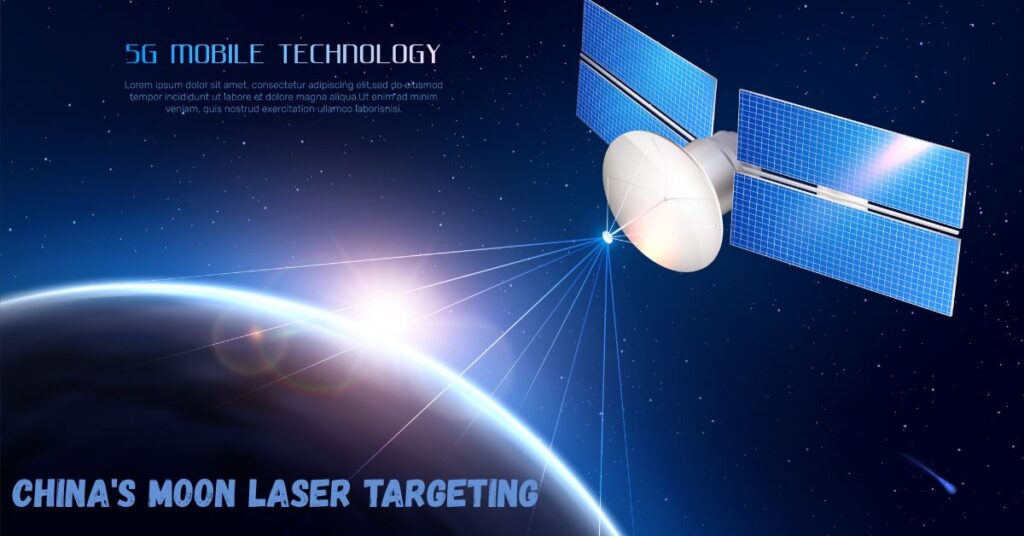

China is making waves in the realm of space technology, and one of its most fascinating innovations is the moon laser targeting system. Imagine a powerful laser beam capable of hitting targets on the lunar surface with pinpoint accuracy. This groundbreaking development opens up new possibilities for space exploration and scientific research.
As we delve into this captivating topic, we’ll explore how China’s moon laser targeting technology works, its potential applications, and what it means for the future of our interactions with outer space. The excitement around this cutting-edge advancement goes beyond just science; it touches upon geopolitics and international cooperation in an era where every nation aims to stake its claim among the stars. Buckle up as we illuminate the skies!
How Does It Work?
China’s moon laser targeting technology operates by utilizing high-powered lasers to establish precise communication and navigation links. This innovative system relies on advanced optics and sophisticated algorithms.
When a signal is transmitted from Earth, it travels at the speed of light toward its lunar destination. Once the beam reaches the Moon’s surface, special sensors detect its reflection, enabling accurate positioning data.
The technology can also be enhanced through adaptive optics. This allows for real-time adjustments based on atmospheric conditions or obstacles in space.
By employing this laser targeting mechanism, China aims to improve mission accuracy significantly while reducing errors associated with traditional radio signals. The ability to communicate instantly opens up new avenues for exploration and potential scientific breakthroughs beyond our planet.
Advantages of Using Moon Lasers in Space Exploration
Moon lasers offer several compelling advantages that can significantly enhance space exploration.
First, they enable precise targeting of lunar surfaces for navigation and communication purposes. This accuracy is crucial for landing spacecraft safely and ensuring successful missions.
Additionally, moon lasers can facilitate high-speed data transmission between Earth and lunar bases. This tech allows scientists to send large quantities of information rapidly, supporting real-time research collaboration.
The ability to map the Moon’s surface in detail is another key benefit. Laser technology provides accurate topographical data, which can inform future missions and resource identification.
Furthermore, using lasers opens doors to innovative experiments on gravitational physics and other cosmic phenomena. Researchers gain access to unique insights that could transform our understanding of the universe’s workings.
Integrating this technology into broader space initiatives may pave the way for international cooperation in scientific endeavors beyond Earth.
Potential Applications and Benefits
China’s moon laser targeting technology opens a realm of possibilities for space exploration. One promising application is in precise navigation systems for lunar missions. Accurate targeting can enhance landing strategies, ensuring spacecraft reach their intended destinations.
Another exciting benefit lies in communication systems. Laser beams can transmit data over vast distances with minimal signal loss, enabling real-time information sharing between Earth and lunar bases.
The technology could also play a crucial role in scientific research. By pinpointing locations on the moon’s surface, researchers can conduct targeted studies of geological features or search for water ice deposits essential for future human colonization efforts.
Moreover, this advanced system may contribute to international cooperation in space endeavors. Countries could collaborate on joint projects that leverage China’s innovative capabilities while fostering global partnerships focused on lunar exploration and beyond.
Controversies Surrounding the Technology
China’s moon laser targeting technology has sparked a myriad of controversies. Critics argue that the potential military applications raise significant security concerns. The prospect of harnessing such advanced technology for weapons purposes can lead to an arms race in space.
Moreover, environmentalists worry about the impact on celestial bodies. Lasers could alter the natural landscapes of the moon and other planets, leading to irreversible damage.
Internationally, there are fears that this technology could disrupt existing treaties surrounding space use. Many countries advocate for peaceful exploration, but advancements like these may blur those lines.
Public opinion is also divided. Some view it as a groundbreaking step for science and exploration while others fear it represents another leap towards militarization in outer space.
As discussions continue, transparency from governmental and scientific bodies remains crucial to address these growing concerns effectively.
Comparison with Other Countries’ Space Technologies
China’s moon laser targeting technology stands out in a competitive global landscape. While countries like the United States and Russia have made significant strides in space exploration, China’s approach is notably innovative.
The U.
S. focuses heavily on satellite navigation systems that enhance precision but lacks targeted lunar capabilities. Meanwhile, Russia employs traditional methods for communication and data transmission without integrating advanced laser technology.
India is emerging with its own ambitious plans but currently relies on conventional tools for lunar missions. Their recent achievements showcase potential but do not yet rival China’s state-of-the-art techniques.
China’s unique combination of lasers and sophisticated tracking mechanisms could redefine how nations interact with celestial bodies. This leap forward may push other countries to rethink their strategies or risk falling behind in this new era of space exploration.
Future Developments and Implications
As China advances its moon laser targeting technology, the future looks promising. Researchers are exploring ways to enhance precision and range. This could revolutionize communication between lunar missions and Earth.
The implications extend beyond mere navigation. Improved accuracy may lead to better data collection from space environments. This will deepen our understanding of the Moon’s geology and potential resources.
International collaboration might also emerge as countries recognize the benefits of shared knowledge in this arena. Joint missions using similar technologies could increase safety and efficiency.
Furthermore, advancements in this field might pave the way for deeper space exploration, reaching asteroids or even Mars with greater confidence.
As these developments unfold, ethical considerations will arise regarding military applications versus peaceful exploration efforts in outer space. The balance between innovation and responsibility is crucial moving forward.
Conclusion
As we delve deeper into China’s moon laser targeting technology, it’s clear that this innovation represents a significant leap in space exploration. The intricate workings of the system showcase not only impressive engineering but also an understanding of how to harness advanced technology for scientific advancement.
The benefits are vast, from improving communication systems to enhancing navigation capabilities in space missions. However, the debates surrounding its ethical implications and potential militarization cannot be ignored. This is a double-edged sword that demands careful consideration by policymakers worldwide.
Comparative analysis with other countries highlights the competitive landscape of space technologies. While nations like the United States and Russia have their own advancements, China’s approach adds a unique dimension to global efforts in lunar research and exploration.
Looking forward, China’s continued investment in moon laser targeting could pave the way for unprecedented discoveries beyond our planet. As technological boundaries expand, it will be fascinating to observe how these developments influence international collaboration or competition within outer space endeavors.
The journey into this new frontier has just begun; staying informed about these advancements will help us understand where humanity is headed next among the stars.